Where to Do a Hot Air Balloon in Morocco
Commercial ballooning in Morocco is concentrated around Marrakech. That is where the licensed operators, the balloons, the ground crews and the daily schedules are. If you want a hot air balloon flight in Morocco, you are almost certainly booking a flight that takes off from the plain within an hour’s drive of Marrakech — whatever the listing calls it.
Which matters, because “Marrakech”, “Agafay” and “Atlas Mountains” get sold as three different destinations, and the honest question is not which region to pick but where the launch field actually is.
The launch zones, and what you see from each
| Zone | Drive from Marrakech | What is underneath you | Reality check |
|---|---|---|---|
| The plain north of Marrakech | 40–60 min | Farmland, douars, irrigation channels, the Jbilet ridge to the north, the High Atlas on the southern horizon | The main operating area. Flat, open, good landing options — which is why it is used |
| Agafay | 40–50 min, southwest | Stone desert, dry riverbeds, no vegetation | Heavily marketed as a balloon destination. Ask any operator where the balloon actually lifts off before you assume you are flying over the stone desert |
| Atlas foothills | Varies | Berber villages, terraced fields, rising ground | Mountains make ballooning harder, not better: rougher air, fewer safe landing fields |
The plain north of Marrakech
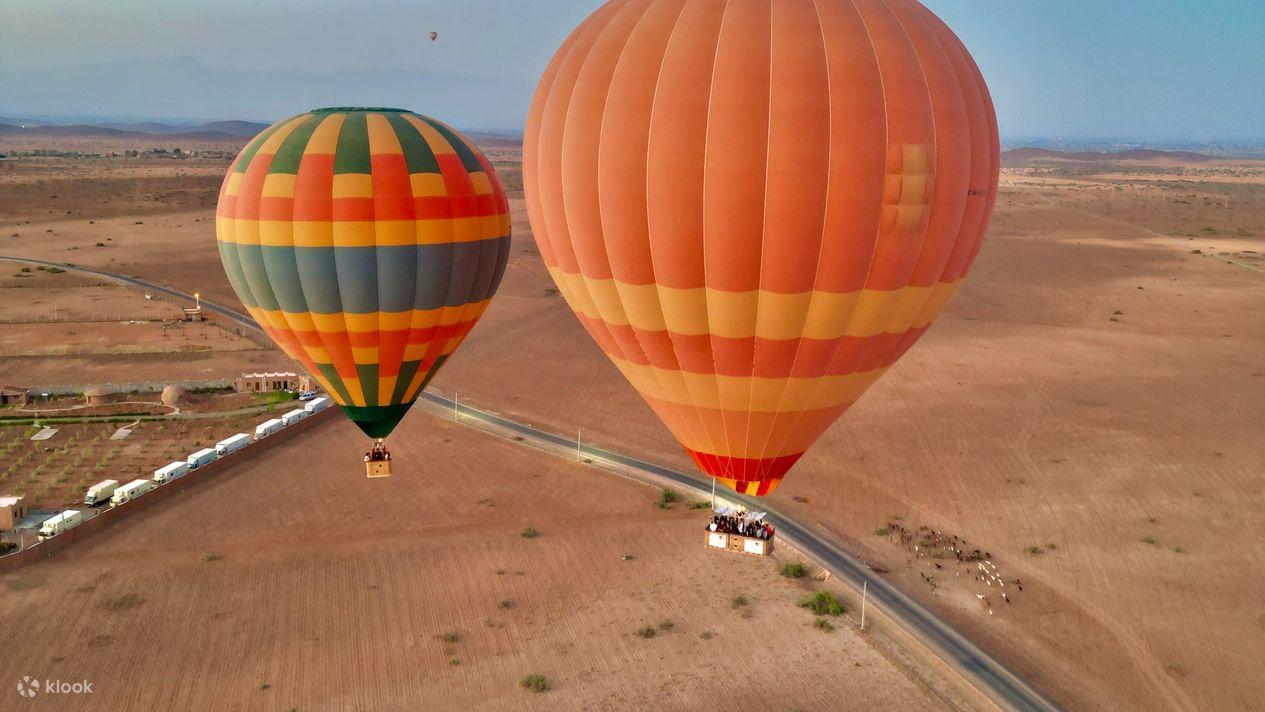
This is where our flights take off, and where most of the region’s flying happens. The reason is unglamorous and important: a balloon cannot steer, so it needs a large, flat, open area with plenty of places to put down safely. The agricultural plain north of the city is exactly that.
What you get is not empty desert. It is working Moroccan countryside at first light — fields, tracks, herds being moved, villages starting their day. The flight usually runs in two halves: high first, for the panorama across the whole region with the Jbilet ridge to the north and the snowline of the High Atlas to the south, then low, drifting a few dozen metres over the douars.
The low half is the part people remember. You are close enough to see people in their courtyards and for them to wave back.
Agafay: what is actually being sold
Agafay is the stone desert southwest of Marrakech, and it has become the default backdrop for everything the city sells — camel rides, dinners, quad bikes, camps. Balloons get marketed the same way.
Be precise when you book. A listing titled “Agafay balloon ride” may mean a flight that launches from the plain and a transfer that passes near Agafay, or it may mean something else entirely. The question that settles it is simple: where does the balloon lift off from, and what will be underneath us? An operator who cannot answer that clearly is not the operator you want.
For what it is worth, the agricultural plain is the more interesting flight. Stone desert photographs well at ground level, from a camp, with a camel in frame. From 500 metres up, it is grey and featureless. Villages, fields and livestock are what make a low pass worth doing.
The Atlas foothills
The mountains look like the obvious answer and they are the wrong one. Rising ground generates unpredictable air far earlier in the morning than flat ground does, and the valleys offer very few fields a chase crew can reach. Flights in the foothills exist, but they are constrained.
The good news is that you do not need to be over the Atlas to see it. From the plain at dawn, on a clear winter morning, the whole southern horizon is mountain — often with snow on it. You get the view without the operational compromise.
What about the Sahara, Merzouga or the coast?
There is no reliable, scheduled commercial balloon operation in the Moroccan Sahara comparable to the one around Marrakech. Distances are enormous, the infrastructure is not there, and the flyable weather window is harder. If you are planning a Morocco itinerary and you want a balloon flight in it, plan it around your Marrakech days.
The same applies to Fez, Essaouira and the coast: interesting places, not ballooning centres.
We checked, in October 2026
Rather than repeat the received wisdom, we went through every balloon operator that publishes prices for Morocco — direct operators and the booking platforms that resell them — and recorded where each one says it lifts off. The result was unanimous: every single commercial balloon flight on sale in Morocco launches within about an hour’s drive of Marrakech. Not one publishes a departure from Merzouga, Erg Chebbi, Zagora, the Dades, Fez, Chefchaouen or anywhere on the Atlantic coast.
This is also where a lot of booking confusion comes from. Several of the most-sold listings carry the word desert in their title — “desert balloon flight”, “flight over the desert in front of the Atlas” — and a reasonable person reads that as the Sahara. It is not. In every case we checked, the “desert” being referred to is the arid, stony ground on the plains and hills around Marrakech, an hour from the city, with the High Atlas on the horizon. It is a genuinely beautiful thing to fly over. It is simply not the Sahara: Erg Chebbi, the dune field most people picture, lies 384 km away in a straight line, and considerably further by road.
So the practical rule for an itinerary holds, with evidence behind it rather than assertion: if you want a balloon flight in Morocco, it belongs on a Marrakech morning. Build the rest of the trip around that, not the other way round.
You choose the take-off point. You do not choose the landing
This is the part that surprises people on a “where” question, and it is worth understanding before you book. A balloon has no steering. The pilot controls one thing — altitude — and uses it to find a layer of air moving in a useful direction. Everything else is the wind’s decision. So the launch field is chosen, briefed and fixed; the landing spot is whatever the morning gives you, somewhere inside a corridor downwind of it.
Three practical consequences follow, and they apply to every operator in Morocco:
- The launch field itself can move. Crews pick the morning’s site from the wind direction, so two flights a week apart can lift off from points several kilometres apart. If an operator will not name an area at all, that is a different problem — but a field that shifts within an area is normal practice, not evasion.
- A chase vehicle follows you. The ground crew tracks the balloon and meets it wherever it comes down, which is why the return leg of the morning is unpredictable in length and why the whole outing runs four to five hours for forty to sixty minutes in the air.
- “Flying over X” is a probability, not a guarantee. On the plain north of Marrakech the corridor is wide and open, so what you see is reliably farmland, douars and the Atlas on the horizon. Anywhere the promise is more specific than that, ask what happens on a morning when the wind says otherwise.
When to go
Every month flies. The differences are the start time and the air.
- December to February. The latest, most civilised start — sunrise as late as 08:32 in January, so pickup is around 07:00. Cold on the ground (an average low of 5.9 °C in January) but often the clearest air of the year, and the best chance of seeing snow on the Atlas.
- March to May. Comfortable temperatures, but statistically the windiest season on the plain, so the highest chance of a morning being called off.
- June to August. Very early starts — a 5 a.m. pickup in June — but the flight itself is the coolest, most pleasant part of a 37 °C day.
- September to November. Arguably the best balance: settled air, moderate temperatures, reasonable start times.
The month-by-month take-off times are in why Marrakech balloons fly at dawn, and what to pack for each is in what to wear for a balloon ride in Marrakech.
What a flight in Morocco costs
A shared basket runs from around 170 € per person booked direct. Private baskets start around 390 € on the marketplaces and 500 € direct, depending on what is actually included. The headline figures are not comparable until you check transport, airtime, whether “private” means private, and what the platform adds at checkout — we break all of that down in what a hot air balloon ride in Marrakech really costs.
How to choose an operator, wherever you fly
- Where is the launch field? A named area, not a region.
- What is the normal airtime? Forty to sixty minutes is the honest range in Morocco.
- Shared or private basket? And if shared, roughly how many people.
- Is transport included, and is it private or a shared round?
- What is the weather cancellation policy, in writing?
- Is the price final, or does a fee appear at checkout?
Anyone offering an afternoon flight has answered a different question than the one you asked. Morocco’s balloons fly at dawn, everywhere, for aerological reasons — see the link above.
Frequently asked questions
Where can you do a hot air balloon in Morocco?
Essentially around Marrakech. The main operating area is the agricultural plain north of the city, roughly 40 to 60 minutes’ drive away. Flights marketed as Agafay or Atlas flights usually launch within the same region.
Is there ballooning in the Moroccan Sahara?
Not as a reliable, scheduled commercial operation. If you want a balloon flight during a Morocco trip, plan it into your Marrakech days.
Do balloons fly over the Agafay desert?
Agafay is sold as a balloon destination, but the launch fields used by Marrakech operators are on the plain. Ask any operator directly where the balloon lifts off and what will be beneath you.
Can you fly over the Atlas Mountains?
Rising ground makes the air unpredictable early and leaves few safe landing fields, so mountain flying is limited. From the plain at dawn you see the High Atlas across the southern horizon anyway.
What is the best month for a balloon flight in Morocco?
September to November for the best overall balance. Winter for the clearest air and the latest start; summer for the earliest start and the coolest hour of a hot day; spring is the most likely to be cancelled for wind.
How much does a hot air balloon cost in Morocco?
From about 170 € per person for a shared flight booked direct, up to 650 € for the seated Royal flight.
How long is a balloon flight in Morocco?
40 to 60 minutes in the air; four to five hours from hotel pickup to drop-off.
Do flights get cancelled often?
Wind and rain ground balloons and the call is made on the morning by the pilot. Spring is the most affected season. Book early in your stay so a cancelled flight can move to another morning.
Which town do balloons take off from in Morocco?
Marrakech is the base, but no town is really the answer: the take-off fields are outside the city, on the open farmland plain to the north, below the Jbilet ridge, among douars rather than in any named locality. Crews pick the exact field on the morning from the wind direction. No other Moroccan town has a scheduled commercial balloon operation, so in practice pickup is from your Marrakech hotel or riad and the drive out takes 40 to 60 minutes.
Our flights over Marrakech
- Classic Flight — 170 € per person: shared basket, hotel pickup, 40 to 60 minutes in the air, Berber breakfast under a caidal tent after landing.
- Private Flight — 500 € per person: your own balloon, your own pilot and ground crew, private VIP car from your hotel.
- Royal Flight — 650 € per person: seated at a table rather than standing, with a Bacha Coffee breakfast served in the air by a steward.
All three include roundtrip transport from your hotel or riad in Marrakech and a flight certificate with your name in Arabic. Book directly on WhatsApp, or call +212 661 45 47 38 — our office in Gueliz answers 8:00 to 17:00, Monday to Saturday.