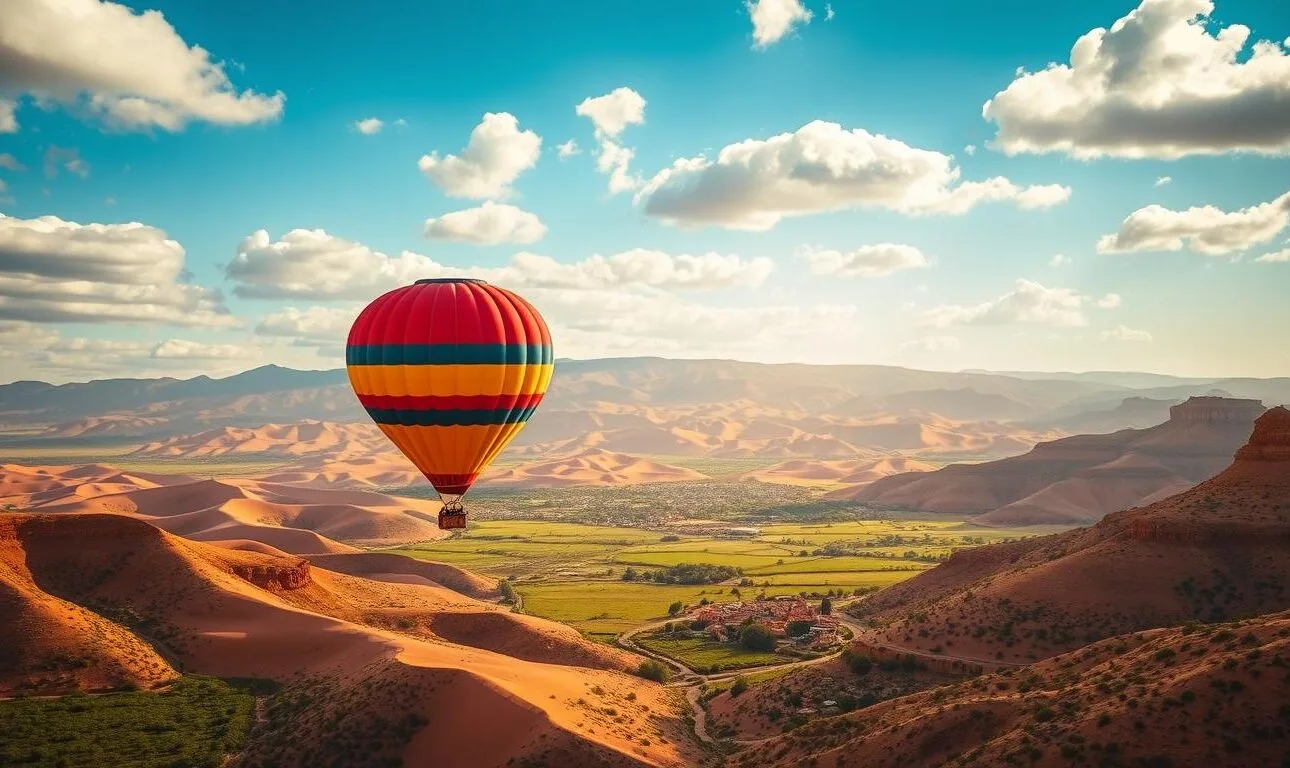
Why Hot Air Balloon Rides in Marrakech Are Best in the Morning
Balloons in Marrakech fly at first light because that is the only part of the day when the air is stable enough to fly them safely. It is not a scheduling preference or a photography gimmick. Once the sun has been up for an hour, the plain starts releasing heat, thermals form, the surface wind turns gusty, and ballooning stops being possible until the following dawn.
Everything else — the light, the cool air, the clear horizon — is a consequence of that constraint, not the reason for it.
What time do balloons actually take off in Marrakech?
Take-off is timed to sunrise, and sunrise in Marrakech moves by more than two hours across the year. A flight in mid-June leaves the ground almost two hours earlier than the same flight in mid-January.
Here are the real figures for Marrakech (31.63° N, 7.98° W), on the 15th of each month, in Moroccan local time. Civil dawn is when there is enough light to work — the moment the crew starts inflating. Sunrise is when the sun clears the horizon, usually while you are already in the air.
| Month | Civil dawn | Sunrise | Expect pickup around |
|---|---|---|---|
| January | 08:05 | 08:32 | 07:00 – 07:30 |
| February | 07:48 | 08:13 | 06:45 – 07:15 |
| March | 07:17 | 07:42 | 06:15 – 06:45 |
| April | 06:38 | 07:03 | 05:35 – 06:05 |
| May | 06:08 | 06:35 | 05:05 – 05:35 |
| June | 05:58 | 06:26 | 04:55 – 05:25 |
| July | 06:09 | 06:37 | 05:05 – 05:35 |
| August | 06:31 | 06:57 | 05:25 – 05:55 |
| September | 06:51 | 07:16 | 05:45 – 06:15 |
| October | 07:10 | 07:35 | 06:05 – 06:35 |
| November | 07:33 | 08:00 | 06:30 – 07:00 |
| December | 07:56 | 08:24 | 06:55 – 07:25 |
Dawn and sunrise are astronomical facts and you can check them. The pickup column is a planning guide, not a promise: the real time depends on where you are staying and on the morning’s weather, and we confirm it in writing when we confirm your booking.
Two practical consequences. In June and July you will be leaving your riad around 5 a.m., in the dark, which is worth knowing before you book a late dinner the night before. In December and January the start is civilised — a 7 a.m. pickup — which is one of the underrated arguments for flying in winter.
The real reason: what the air does at dawn
A hot air balloon has no steering. It goes where the air goes, and the pilot’s only control is altitude — climbing or descending into a layer of air moving in a different direction. That makes the balloon completely dependent on the air behaving predictably, and there is exactly one window a day when it does.
Overnight, the ground cools and the air settles
Through the night the plain radiates its heat away to a clear sky. The air in contact with the ground cools faster than the air above it, which leaves the coldest, densest air at the bottom — a temperature inversion. Inverted air resists vertical movement. Nothing rises, nothing churns, and the surface wind drops to near nothing.
Then the sun switches the plain back on
Once the sun is properly up, the ground heats faster than the air. Bubbles of warm air start breaking away and rising — thermals. Each one drags surrounding air in behind it, so the surface wind becomes gusty and unpredictable, changing speed and direction minute to minute. That is excellent for paragliders and unusable for a balloon, which cannot dodge anything.
Why the Marrakech plain in particular
The flat, dry, stony ground north of Marrakech heats quickly and strongly. It is a good thermal generator, which is precisely why the flyable window here closes early and closes hard. Add the Jbilet ridge to the north and the High Atlas to the south, both of which start funnelling air as the day warms, and the case for dawn stops being a preference.
This is why you will not find an afternoon balloon flight anywhere in the Marrakech region, at any price, from any operator. If someone offers you one, that is the signal to walk away.
What the dawn slot gives you, beyond safety
- Air you can actually see through. Dust and haze build over the plain during the day. At dawn the air is at its clearest, which is when the High Atlas is visible on the southern horizon.
- Temperatures you can stand. In July the daily maximum in Marrakech averages 37.7 °C, but the daily minimum averages 20.6 °C. You are flying in the second number, not the first.
- Light that does the work for you. Low sun, long shadows across the fields, the villages picking up colour as the light arrives. It is the one hour of the day this landscape is photogenic.
- The ground waking up underneath you. On the low part of the flight you pass over douars starting their day, farms, animals being moved. An hour later that scene is over.
What it means for the rest of your day
A balloon morning runs about four to five hours door to door. Even in summer, with a 5 a.m. pickup, you are back at your riad by mid-morning with the whole day ahead of you. In winter you are back for a late lunch.
The practical advice is to put the balloon on your first or second free morning, not your last. Balloons get grounded by wind and rain, the call is made on the morning itself, and a cancelled flight has to move to another day. If your only free morning is the day before you fly home, you have nowhere to move it to.
How to survive a pre-dawn start
- Eat dinner early the night before. Breakfast is at the end of the morning, not the start of it.
- Lay your clothes out before bed. You will be dressing in the dark, half awake, at an hour when decisions are expensive. Our what to wear guide has the month-by-month list.
- Tell the riad the night before. Many medina riads lock their door and staff sleep in; someone needs to be awake to let you out.
- Give us the riad name, not just the address. The medina is not navigable by street number in the dark.
- Do not skip the sleep. Standing in a basket for an hour after two hours of sleep is not the experience you paid for.
When the morning says no
Balloons do not fly in strong wind or rain, and the decision is taken at the launch site on the morning itself, by the pilot, looking at the actual conditions. It is not a commercial decision and it is not negotiable — which is exactly what you want from the person flying you.
Winter mornings are more often calm than windy, which surprises people. Spring can be the most disrupted season on the plain. Whatever the month, the mitigation is the same: book early in your stay so there is room to move.
Frequently asked questions
What time do hot air balloons take off in Marrakech?
At first light, which means anywhere between about 06:30 in June and 08:30 in January. Pickup from your hotel is roughly an hour to ninety minutes before sunrise — see the table above for your month.
Why can’t I fly in the afternoon?
Because by then the plain has heated up and is producing thermals and gusty surface wind. A balloon cannot steer, so it needs stable air. No operator in Marrakech flies in the afternoon.
Is sunset ballooning possible in Marrakech?
In principle the air stabilises again in the evening, but the window is short and far less reliable than dawn, and the whole operation — inflation, chase vehicle, landing in a field — is built around morning light. Marrakech flies at sunrise.
What is the best month to fly?
Any of them fly. Winter gives you the latest, most comfortable start and often the clearest air over the Atlas. Summer gives you the earliest start and the coolest part of a very hot day. Spring is the most likely to be disrupted by wind.
How early do I need to wake up?
Plan to be up about thirty minutes before pickup. In June that means a 4:30 alarm; in January, more like 6:30.
Do I see the sunrise from the air?
Usually yes. Inflation happens in the half light of civil dawn and the balloon is generally up by the time the sun clears the horizon.
How long is the whole morning?
About four to five hours from pickup to drop-off, of which 40 to 60 minutes are in the air. The rest is transport, inflation, the flight briefing and breakfast after landing.
Is it cold up there?
The temperature in the basket is close to the temperature on the ground — you rise with the air, so you do not feel wind chill. The cold part is standing on the plain before take-off, before the sun is up.
Our flights over Marrakech
- Classic Flight — 170 € per person: shared basket, hotel pickup, 40 to 60 minutes in the air, Berber breakfast under a caidal tent after landing.
- Private Flight — 500 € per person: your own balloon, your own pilot and ground crew, private VIP car from your hotel.
- Royal Flight — 650 € per person: seated at a table rather than standing, with a Bacha Coffee breakfast served in the air by a steward.
All three include roundtrip transport from your hotel or riad in Marrakech and a flight certificate with your name in Arabic. Book directly on WhatsApp, or call +212 661 45 47 38 — our office in Gueliz answers 8:00 to 17:00, Monday to Saturday.
Sunrise and civil dawn computed for Marrakech (31.63° N, 7.98° W) in Moroccan local time, UTC+1. Temperature normals: Marrakesh Menara Airport, 1991–2020.